

Choosing a Stereo Microscope for Industrial Inspection requires more than comparing magnification numbers. Different inspection tasks involve different component sizes, surface conditions, working distances, lighting requirements, and observation methods. A suitable Stereo Microscope should provide a clear view of the inspection area while allowing operators to work comfortably and consistently. For industrial applications, the right Stereo Microscope can support inspection of Small Parts, assemblies, electronic components, precision products, jewelry, mechanical parts, and other objects where surface details matter.
This guide explains how to choose a Stereo Microscope for industrial inspection. It focuses on practical factors such as magnification, working distance, optical clarity, illumination, focusing, viewing comfort, specimen size, and application requirements. Instead of choosing a microscope simply because it has a high specification, it is better to match the Stereo Microscope to the actual inspection process.
A Stereo Microscope is an optical microscope designed to provide a three-dimensional view of an object. It normally uses two optical paths so that the observer receives slightly different images through the two eyes. This creates depth perception and helps the operator understand the physical shape and surface structure of a small object.
In industrial inspection, a Stereo Microscope is commonly used to examine surfaces, edges, connections, small components, assemblies, and other physical details. The object can often remain intact during inspection, which makes the Stereo Microscope practical for routine quality checking and hands-on work.
Compared with microscopes designed mainly for prepared slides, a Stereo Microscope provides a more practical working distance for many inspection tasks. The operator can position or manipulate a component while observing it through the microscope. This can be useful when inspection and adjustment need to happen at the same workstation.
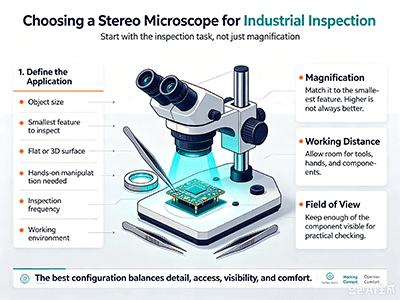
The first step in choosing a Stereo Microscope is understanding what you actually need to inspect. Industrial inspection covers many different tasks, and each task can require a different microscope configuration.
For example, one production line may need to inspect electronic components, while another may examine mechanical parts, plastic components, metal surfaces, jewelry, connectors, or small assemblies. The required magnification and working distance can vary considerably between these applications.
Before selecting a Stereo Microscope, ask several basic questions. What is the typical size of the object? Which details need to be inspected? Is the object flat or three-dimensional? Does the operator need to manipulate the object while observing it? Is the inspection performed continuously or only during sampling? What type of lighting is available?
These questions help define the actual requirements. A Stereo Microscope selected for small electronic components may have different requirements from a Stereo Microscope used for Jewelry Inspection or mechanical assembly checking.
| Inspection Requirement | Important Stereo Microscope Factor | Reason |
|---|---|---|
| Small surface details | Suitable magnification | Provides sufficient visual detail |
| Hands-on inspection | Working distance | Allows space for tools and components |
| Three-dimensional parts | Depth perception | Helps the operator understand physical structure |
| Reflective surfaces | Suitable illumination | Helps control glare and improve visibility |
| Routine inspection | Comfortable focusing and viewing | Supports repeated observation |
Magnification is one of the most important factors when choosing a Stereo Microscope, but higher magnification is not always better for industrial inspection. The correct magnification depends on the size of the feature that needs to be observed.
If the magnification is too low, small defects or fine surface details may not be visible. If the magnification is unnecessarily high, the field of view becomes smaller and the operator may lose the overall context of the component.
A practical Stereo Microscope should provide magnification that matches the inspection task. For routine inspection of relatively large small parts, moderate magnification may be sufficient. For detailed examination of tiny structures, a higher magnification range may be useful.
Users should also consider whether they need variable magnification. A variable-magnification Stereo Microscope can allow the operator to start with a wider view and then increase magnification when a particular area requires closer inspection.
When comparing a Stereo Microscope, do not evaluate magnification alone. Consider magnification together with field of view, working distance, image clarity, and the size of the inspection target.
Working distance is particularly important when selecting a Stereo Microscope for industrial inspection. Working distance refers to the space between the objective lens and the specimen when the image is properly focused.
A suitable working distance gives the operator enough room to position and manipulate the inspection object. This is useful when the operator needs to use tweezers, small tools, cleaning equipment, or other accessories during inspection.
If the working distance is too short, the operator may have difficulty accessing the object. It can also become inconvenient when inspecting relatively tall components or assemblies.
A Stereo Microscope with a practical working distance can make industrial inspection more comfortable. It can also reduce interference between the optical system and the object being inspected.
For this reason, working distance should be considered at the same time as magnification. In many industrial applications, the most useful Stereo Microscope is not necessarily the one with the highest magnification, but the one that provides a workable balance between magnification and physical access.
Image quality is central to any industrial inspection process. A Stereo Microscope should provide a clear and stable image so that the operator can distinguish relevant surface features.
Optical clarity depends on the complete optical system rather than one component alone. Objective lenses, eyepieces, optical alignment, illumination, mechanical stability, and focusing all contribute to the final image.
When comparing a Stereo Microscope, pay attention to how clearly the edges, textures, small structures, and surface changes can be observed. Industrial inspection often involves comparing similar components, so stable image quality is important for repeated visual checking.
For routine inspection, the operator may spend many hours using the Stereo Microscope. A clear image can make observation easier and reduce the need to repeatedly adjust the equipment.
Lighting can strongly influence the performance of a Stereo Microscope. Different industrial surfaces reflect light differently. Metal, plastic, glass, coated surfaces, electronic components, and polished products may require different lighting approaches.
Reflected illumination is commonly useful when inspecting the surface of solid objects. Light is directed toward the object and reflected back through the optical system. The purpose is to make surface details easier to see.
However, excessive direct light can create glare on reflective surfaces. Too little light can make small surface differences difficult to identify. A suitable Stereo Microscope should therefore be considered together with an appropriate illumination setup.
Before purchasing a Stereo Microscope, consider the surface characteristics of the objects being inspected. If the production line handles different materials, adjustable or suitable illumination can make the inspection process more flexible.
Focusing is another practical factor when choosing a Stereo Microscope. The operator needs to bring the inspection area into clear focus and maintain that focus during observation.
A stable focusing mechanism can make repeated industrial inspection easier. Smooth focusing control is particularly useful when the operator moves between objects with different heights or surface structures.
For industrial work, the focusing system should be easy to operate without requiring excessive adjustment. If operators need to inspect many components during a shift, convenient focusing can help create a more consistent workflow.
A Stereo Microscope should also remain mechanically stable while the operator adjusts focus. Unwanted movement can make detailed inspection more difficult and may require repeated repositioning of the object.
The size of the object should influence the choice of Stereo Microscope. Small electronic components may require a different setup from larger mechanical assemblies. The object must fit comfortably within the available observation area while leaving enough space for the operator to work.
The shape of the object is also important. Flat surfaces are generally straightforward to observe, while curved, recessed, raised, or irregular surfaces can require different positioning and lighting.
A Stereo Microscope is useful for three-dimensional objects because depth perception can help the operator understand the relationship between different surfaces. This can be particularly useful when checking small assemblies, connectors, mechanical parts, and other components with multiple physical features.
Before selecting the microscope, it can be helpful to test the actual inspection object. A practical test can show whether the magnification, working distance, illumination, and focusing system are suitable for the real production environment.
Industrial inspection can involve repeated microscope use, so operator comfort should not be overlooked. A Stereo Microscope should allow the user to maintain a comfortable viewing position while performing routine inspection.
The eyepiece position, focusing controls, working distance, and overall microscope configuration can affect the user's experience. If the operator frequently needs to bend forward, reposition the object, or make complicated adjustments, the inspection process may become less convenient.
A comfortable Stereo Microscope can support consistent inspection work by making repeated observation easier. This is especially relevant for production environments where many components must be checked during a normal working period.
Operator comfort should not replace optical performance as a selection criterion, but it should be considered alongside image quality, magnification, working distance, and focusing control.
Electronic components often contain small connections, surfaces, soldered areas, pins, and other details that may require magnified inspection. A Stereo Microscope can provide a practical view of these components while allowing operators to manipulate them.
For electronics inspection, the selection should consider the size of the components and the smallest features that need to be observed. Magnification should be sufficient for the inspection task without unnecessarily reducing the field of view.
Working distance is also important because technicians may need to use small tools while observing the component. A suitable Stereo Microscope can provide the physical space needed for these operations.
Small mechanical parts can have threads, edges, holes, grooves, surfaces, and other physical features that require close visual examination. A Stereo Microscope can help operators inspect these structures while maintaining a three-dimensional view.
For mechanical inspection, the microscope should be selected according to the dimensions and shape of the components. If the object is relatively large, working distance and field of view become especially important.
Lighting should also be considered because metal surfaces can produce reflections. A suitable Stereo Microscope and illumination arrangement can make surface features easier to distinguish.
Jewelry and other small products often require detailed surface observation. A Stereo Microscope can be useful because it provides depth perception and allows the operator to observe the physical appearance of the product.
For jewelry inspection, users may need to examine small surface features, settings, edges, gemstone positions, or workmanship. The microscope should provide sufficient magnification while retaining a practical working distance.
The same principle applies to other small manufactured products. Instead of selecting a Stereo Microscope based only on maximum magnification, users should consider the actual size of the product and the smallest feature that needs to be inspected.
When comparing different Stereo Microscope configurations, it is useful to create a simple checklist. This helps users focus on the requirements that directly affect inspection work.
| Factor | Questions to Ask | Industrial Inspection Consideration |
|---|---|---|
| Magnification | What is the smallest feature? | Choose a useful range rather than maximum magnification alone |
| Working distance | How much space is needed around the object? | Important for hands-on inspection |
| Field of view | How much of the object must be visible? | Affects inspection efficiency |
| Illumination | Is the surface reflective, dark, or uneven? | Lighting should match the material |
| Focusing | How frequently will focus be adjusted? | Stable and practical controls support repeated inspection |
| Viewing comfort | How long will operators use it? | Important for routine inspection work |
One of the most common mistakes when choosing a Stereo Microscope is focusing only on magnification. Magnification tells you how large an object appears, but it does not describe the entire observation experience.
For industrial inspection, image clarity, field of view, working distance, illumination, focusing, and mechanical stability can be equally important. A microscope with very high magnification may not be convenient if the inspection target is relatively large or if the operator needs to manipulate the object.
A more practical approach is to define the inspection task first. Then select the Stereo Microscope configuration that provides enough detail while preserving a useful field of view and working distance.
A Stereo Microscope should fit the complete inspection workflow rather than operate as an isolated piece of equipment. Consider how the component arrives at the workstation, how it is positioned, what areas need to be checked, how the operator records results, and how frequently the microscope is used.
If the microscope is used for sampling inspection, the configuration may be different from a workstation where every component is inspected. The inspection frequency can influence the importance of viewing comfort, focusing speed, object positioning, and overall workflow efficiency.
It is also useful to consider whether the microscope will remain in one location or be moved between workstations. The intended working environment can influence the preferred configuration and supporting equipment.
The main Stereo Microscope is only one part of an inspection setup. Depending on the application, users may also need suitable illumination, stages, eyepieces, objective components, positioning equipment, or other Microscope Accessories.
Before placing an order, confirm which accessories are included and which items require separate selection. This can prevent compatibility problems after delivery.
For industrial users, documentation is also worth checking. Product documentation can help operators understand focusing, adjustment, maintenance, and basic operating procedures. Clear documentation is especially useful when multiple operators use the same Stereo Microscope.

When purchasing a Stereo Microscope from a manufacturer, it is reasonable to ask how the product is checked before shipment. Assembly inspection, optical performance checking, focusing and mechanical function testing, and appearance inspection are practical areas to consider.
The exact inspection procedure depends on the product configuration and manufacturer. Buyers should request applicable inspection or certification documents when these are required for their project or market.
For international industrial orders, packaging and transportation should also be considered. A Stereo Microscope contains optical and mechanical components that need suitable protection during handling and transportation.
Packaging is an important part of purchasing a Stereo Microscope for industrial use. Suitable packaging can help protect the optical and mechanical components during transportation.
A typical packaging approach may include inner cushioning, dust-proof materials, an individual product box, and reinforced export cartons or outer packaging. The exact packaging method should match the microscope configuration and transportation conditions.
Delivery requirements should also be confirmed before the order is placed. The agreed delivery should clearly identify the microscope configuration, accessories, documentation, and any applicable certification or inspection documents.
For international orders, transportation can be arranged by air, sea, express service, or another suitable logistics method depending on destination, order size, urgency, and shipping conditions.
Before selecting a Stereo Microscope for industrial inspection, review the following points:
Define the inspection object and smallest feature that must be observed.
Choose a suitable magnification range rather than focusing only on maximum magnification.
Check the working distance required for the actual inspection process.
Consider the field of view and how much of the component must remain visible.
Select illumination according to the surface material and inspection environment.
Check whether focusing controls are practical for repeated use.
Consider operator viewing comfort during routine inspection.
Confirm compatibility with required accessories.
Ask about assembly, optical, mechanical, and appearance inspection before shipment.
Confirm packaging, delivery standards, transportation, payment, and documentation before ordering.
Choosing a Stereo Microscope for industrial inspection should begin with the actual inspection task. The microscope needs to provide the right balance of magnification, working distance, field of view, optical clarity, illumination, focusing control, and operator comfort.
A suitable Stereo Microscope can be useful for inspecting electronic components, mechanical parts, jewelry, small assemblies, precision products, and other solid objects. Its three-dimensional viewing capability and practical working distance make it suitable for inspection tasks where users need to understand surface details and physical structure.
Rather than selecting a Stereo Microscope based on one specification, compare the complete configuration with your inspection workflow. Consider the object size, smallest inspection feature, working distance, lighting, magnification, focusing, accessories, packaging, and delivery requirements.
For industrial buyers, this application-based approach makes it easier to identify a Stereo Microscope that fits the real working environment. The goal is not simply to obtain a microscope with higher numbers, but to choose an optical inspection system that provides clear observation, practical operation, and suitable support for the required inspection process.
Add: No.70 Zhenxing East Road, Zhangshui Town,Haishu District,Ningbo City,Zhejiang,China
Contact Person: Mr. Xu Contact Number:+86 13777211956
Tel:+86 574-88152588/574-88152566
Fax:+86 574-88152570
Post Code:315161
E-mail:chinahg@hgopt.com
邮箱

本网站使用 cookie 来确保您在我们的网站上获得最佳体验。
 English


 Whatsapp
 电话
电话 邮箱
邮箱 留言
留言
评论
(0)